
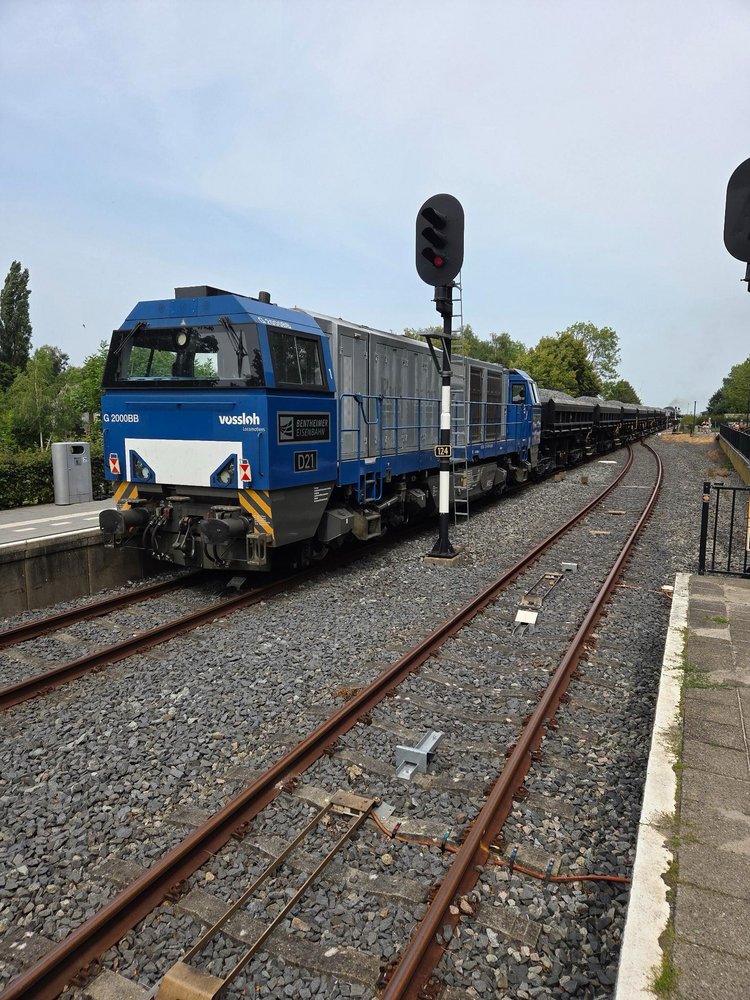
Both Deutsche Bahn and Arriva are hard at work during this final phase of the Wunderline project. The Bad Nieuweschans–Leer section has recently been declared technically ready, meaning that trains can now run here at a maximum speed of 70 km/h. The timetable has been aligned with the opening hours of the Friesenbrücke.
Load-testing runs
Deutsche Bahn is currently carrying out the final load-testing runs, which began at the end of July. These involve heavy transport journeys carrying 1,000 tonnes of gravel, travelling back and forth along the restored Bad Nieuweschans–Leer line with the aid of two locomotives. On this route, they pass through the new intermediate stations of Bunde, Weener and Ihrhove. These load tests are designed to assess how much train traffic the route can handle and how the track performs under maximum load.
Driver training runs
Meanwhile, Arriva is working on the training programme for the drivers who will be operating trains on the route from Groningen – and later from Leeuwarden – to Leer. The training runs will start at a maximum speed of 70 km/h. Once the load tests have been completed, the training runs will be carried out at speeds of up to 120 km/h. This will also be the speed in the future timetable.
Deutsche Bahn’s test runs are taking place later than originally planned. As a result, Arriva will start the practical training for train drivers slightly later. Given the number of drivers being trained and the holiday period, this training programme will take at least a few more weeks.
Cross-border rail passengers
Once Deutsche Bahn and Arriva have completed their work and the train drivers have successfully completed their training, which includes driving at speeds of up to 120 km/h, passenger trains will be able to start running. With a change at Leer, passengers will then be able to travel from Groningen to Bremen quickly and comfortably.